
Does Weight Loss Lower Blood Pressure? The Honest Numbers
 By Paul Butler · Online Coach & Personal Trainer
Blood pressure is the strong, silent type, and not in the appealing way. It does not hurt, it does not show up in the mirror, and it is perfectly content to say nothing at all for twenty years.
Which is why a high reading tends to arrive as a surprise, usually at an appointment you booked about something else entirely.
So: does weight loss lower blood pressure? Yes. Reliably, measurably, and by more than most people expect. The rough figure worth carrying around is about one point off your top number for every kilogram you lose. Lose half a stone and you are looking at something like three points. That is not nothing, and for plenty of people it is the difference between a conversation about tablets and a conversation about six months.
What the research actually found
The number most worth knowing comes from a meta-analysis published in Hypertension in 2003, which pooled 25 randomised controlled trials covering 4,874 people.
Across those trials, an average weight loss of 5.1 kg, achieved through eating less, moving more, or both, lowered systolic blood pressure by 4.44 mmHg and diastolic by 3.57 mmHg. Expressed per kilogram, that is 1.05 points systolic and 0.92 diastolic.
Hence the rule of thumb: roughly a point per kilogram. It is not a law, and individuals vary a great deal, but it is a genuinely useful way to think about it.
The other finding is worth having too. People who lost more than 5 kg saw considerably bigger falls, around 6.6 systolic, than those who lost less, around 2.7. So the effect scales. It does not plateau after a token amount.
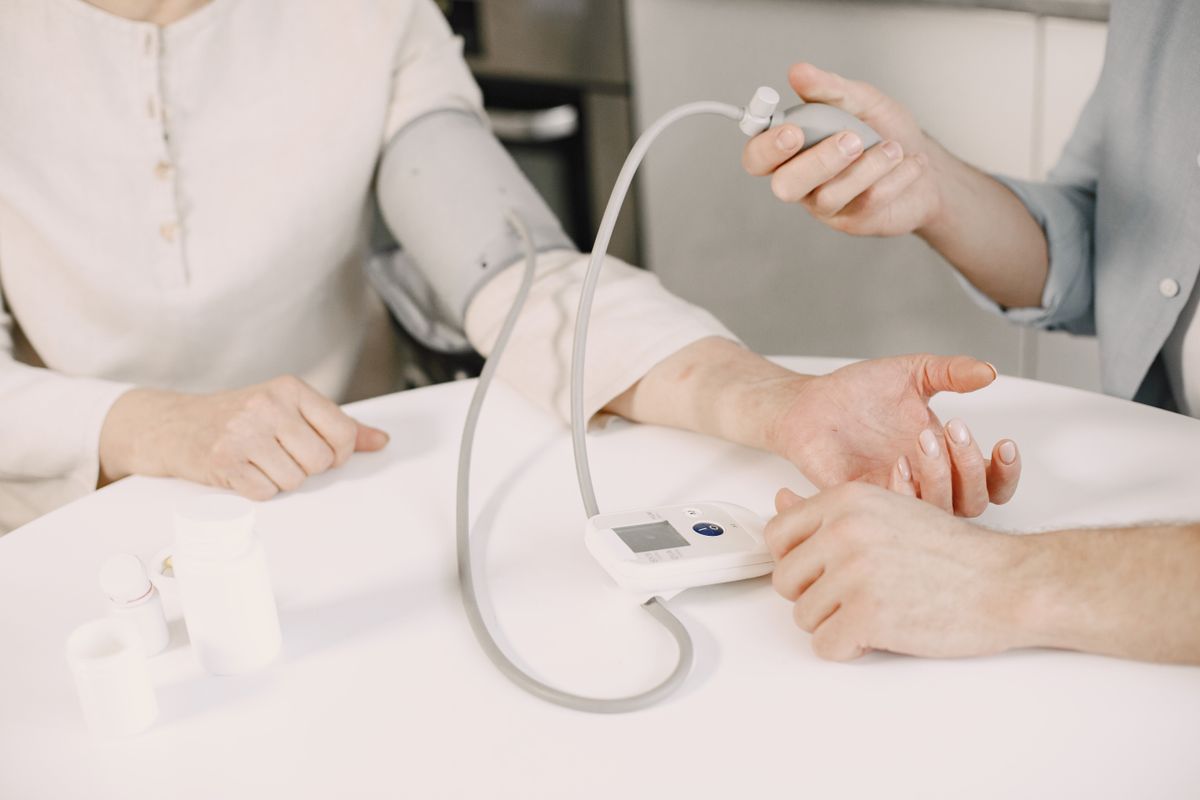
Quick translation for anyone who has never had this explained: the top number, systolic, is the pressure when your heart beats. The bottom one, diastolic, is the pressure between beats. The NHS has the full picture on what counts as high, and it is worth two minutes of your time if you have just had a reading you did not like.
Why losing weight does this
Without a physiology lecture, because you do not need one.
Carrying extra weight means your heart has more body to supply, so it works harder and pushes against more resistance. Extra fat tissue, particularly round the middle, also affects the hormone systems that control how much salt and water your body holds onto, and it tends to keep the whole system running at a slightly higher idle. Losing weight eases all of that at once.
That is also why the improvement starts early. You do not need to reach a goal weight for your blood pressure to respond, which is genuinely encouraging if the target on the chart looks a long way off. The first few kilos are already doing work.
How much would you actually need to lose?
Less than people fear, usually.
Around 5 kg, which is roughly three quarters of a stone, produced that four-point drop in the trials. If you are carrying a lot, aiming for 5 to 10% of your body weight is the standard target and is where most of the health benefit shows up. For someone at 100 kg, that is 5 to 10 kg.
Whether that is enough to change anything medically is not my call, and it depends where you are starting from and what else is going on. But it is a realistic target rather than an intimidating one, and I have written honestly about what that pace looks like in how quickly can I lose a stone.
Worth adding: how you lose it matters. Crash approaches that cost you muscle tend to be the ones people abandon, and blood pressure that comes down for two months and goes back up has not achieved much. Slower and kept beats faster and returned, every time.
The medication conversation, which matters more than the rest
If you take blood pressure tablets, read this bit twice.
Losing weight can lower your blood pressure enough that your current dose becomes too strong. That is a good problem, but it is still a problem: blood pressure that goes too low causes dizziness, light-headedness and falls. So tell your GP that you are actively trying to lose weight, and get your readings checked as you go.
Do not adjust or stop anything yourself, however good the numbers look. That is not me being cautious for the sake of it. In the DiRECT trial I wrote about last week, researchers withdrew participants' blood pressure medication deliberately, at the start, under supervision, precisely because they knew the weight loss would change what was needed. That was a managed clinical decision with monitoring around it. It is the clearest possible illustration that this is a doctor's job.
I am a coach. I can help you lose the weight. Your GP handles what that means for your prescription.
What else moves the needle
Weight is one lever. These are the others worth knowing about, roughly in order of how much most people can gain from them.
- Salt. The bulk of it is not the salt cellar, it is bread, sauces, processed meat and ready meals. Reading labels for a week is genuinely eye-opening.
- Walking. Regular, unremarkable, daily walking helps independently of weight loss. It is the cheapest thing on this list.
- Alcohol. One of the more direct effects there is. A few drink-free days a week does more than most people would guess.
- Sleep. Short sleep pushes blood pressure up and makes everything else harder, which is the argument I made in the 8-hour sleep rule.
- Strength training. Helps, and protects the muscle you want to keep while losing fat. If time is the problem, the smallest possible version of your workout covers what to do on a bad week.
Get your house in order first. Sleep, food, steps, then the clever stuff. It is dull advice and it is the advice that works.
Frequently asked questions
How quickly does blood pressure drop after losing weight?
Sooner than most people expect. The trials tracked reductions alongside the weight loss itself rather than after some delay, so improvements typically show up within weeks rather than months. You do not have to reach a goal weight before anything happens.
Can I come off blood pressure tablets if I lose weight?
Some people can, and it is a genuine possibility worth discussing, but only your GP can make that call and only with monitoring. Stopping on your own is dangerous because blood pressure often creeps back without symptoms, so you would not feel it going wrong.
How much weight do I need to lose to lower my blood pressure?
Around 5 kg produced a four-point drop in systolic pressure across the trials, and 5 to 10% of your body weight is the usual clinical target. Losing more does more, but the early kilos count and there is no threshold you have to cross before benefit begins.
Does exercise lower blood pressure on its own, without weight loss?
Yes, regular activity has its own effect independent of what the scale does, and walking is the most accessible version. Combining the two works better than either alone, which is roughly what the trials in that meta-analysis were doing.
Is it the weight or the diet that lowers blood pressure?
Both, and they are difficult to separate, because losing weight usually means eating differently, often with less salt and less alcohol. The meta-analysis measured weight change specifically, so the per-kilogram figure holds however the weight came off.
Should I buy a home blood pressure monitor?
They are useful for spotting trends, particularly if your readings are borderline, and many GPs welcome home readings. Take them sitting, rested, at the same sort of time, and judge patterns over weeks rather than reacting to a single number. Ask your GP which readings they want.
The first few kilos do real work here, and they come from structure rather than heroics. DM me STARTING on Instagram @paulbutler.coach and I'll send you The Starting Point: five days of the fundamentals, then a four week plan built round your real week. No cost, no catch.
Or begin right now at paulbutlercoach.co.uk, and read How Quickly Can I Lose a Stone? for a realistic timeline.
This article is general information from a coach, not medical advice. Never stop, reduce or change blood pressure medication without your GP: weight loss can lower your blood pressure enough that your dose needs adjusting, and that is a decision for your doctor. If you have been told your blood pressure is high, or you get chest pain, severe headaches or visual changes, seek medical advice. Research cited: Neter et al., Hypertension 2003, linked in the text. Images sourced from Pexels (free to use): Mikhail Nilov, Gustavo Fring.
