
Why Do I Feel Guilty After Eating, and How to Stop It
 By Paul Butler · Online Coach & Personal Trainer
Nobody has ever eaten one biscuit and then felt a proportionate amount about it.
It is always either nothing at all or a full internal inquiry. So here is why you feel guilty after eating, and the more useful point underneath it: the guilt is not the small problem that follows the big one. In terms of what it actually costs you, the guilt is the big one. One meal has never changed anyone's body. The three days of deciding you have ruined everything absolutely have.
Why do I feel guilty after eating?
Because somewhere along the way food got sorted into good and bad, and eating the bad kind started to feel like a character failure rather than a Tuesday. Add a diet with rules you can break, and every meal becomes a pass or a fail. Guilt is just what failing feels like.
The cost is never the meal
There is a well documented pattern in the research on dieting that psychologists named, with more honesty than usual, the what-the-hell effect. Someone restricting their eating has something they had decided was off limits, decides the day is already ruined, and eats considerably more than they would have if they had never had the rule in the first place.
The rule creates the breach. The breach creates the guilt. The guilt creates the rest of the evening.
| After a meal you did not plan | The guilt route | The useful route |
|---|---|---|
| That evening | "I have ruined it, may as well finish the packet" | Nothing. It was a meal |
| Next morning | Skip breakfast to make up for it | Normal breakfast, hit your protein |
| By Wednesday | Under-eaten, ravenous, off again | Unremarkable week |
| Sunday night | "Right. Monday. Properly this time" | No announcement required |
| What it actually cost | One meal became five days | One meal stayed one meal |
Read the left column and notice that none of the damage is in the first row. The meal is the cheapest thing on that list.
What happens when people are kinder to themselves instead
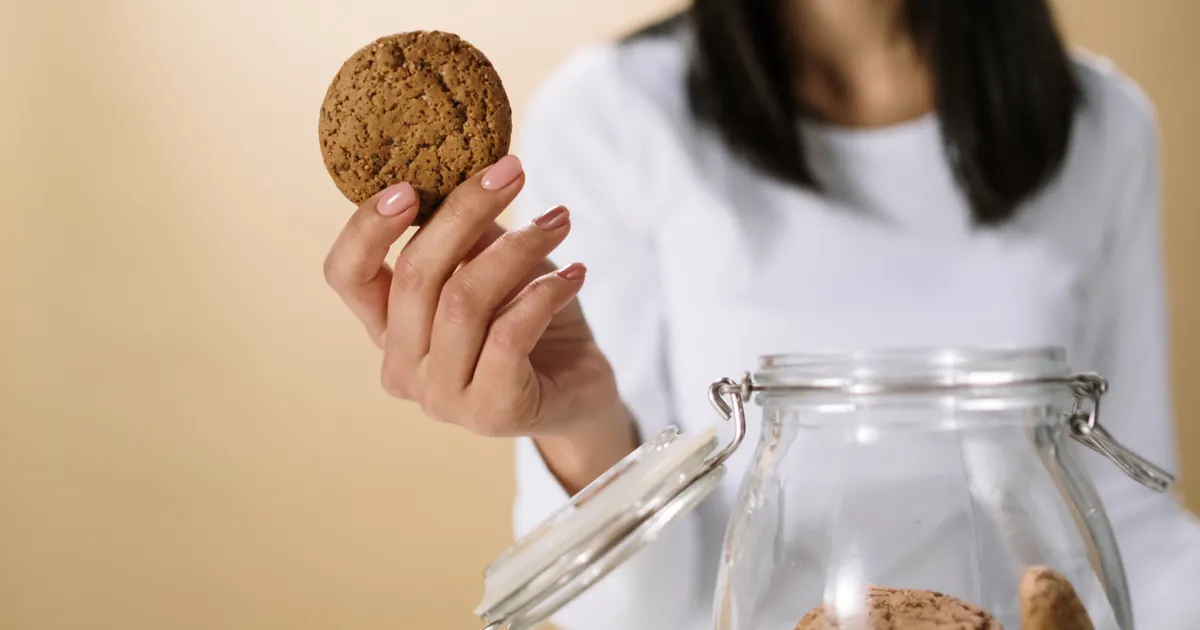
This sounds like the soft option, so it is worth knowing it has been studied in exactly the people we are talking about, rather than in students given a milkshake.
Fifty six adults who were overweight and actively trying to lose weight logged their eating and their feelings twice a day for a fortnight. The researchers looked at what happened after a lapse, depending on whether people were hard on themselves or not.
"...self-compassion was positively related to intentions and self-efficacy to continue dieting, and negatively related to negative affective reactions to the lapses."
In plain English: the people who did not flog themselves after a slip were more likely to believe they could carry on, and more likely to intend to. Guilt was the thing in the middle driving it.
Two honest caveats, both the authors' own. It was a small study, fifty six people, and compliance with the twice daily logging was poor. And being kind to yourself did not, on its own, make anyone lose weight. What it did was keep them in the game, which over a year is the only thing that has ever mattered.
What to do instead, practically
- Eat the next meal normally. Not a smaller one. Not a salad as penance. The correction people reach for is what turns one meal into a week.
- Do not try to earn it back. Adding an extra session to burn off a dessert teaches your head that food is a debt, and that is a worse problem than the dessert.
- Stop announcing fresh starts. Nobody gains weight because they ate biscuits on a Tuesday. They gain it because every small decision becomes permission for the next one.
- Build the thing you want to eat into the week on purpose. A plan with no room in it for a Friday is not a plan, it is a countdown. Banking a bit through the week is how people actually manage it.
- Ask what happened before you ate. Guilt is loud, so it drowns out the useful question. Tired? Stressed? Under-eaten since breakfast? That is usually where the answer is.
Where this stops being about biscuits

I am going to be careful here, because there is a line and I am not the person to walk anyone across it.
Ordinary food guilt is a diet culture problem and a rules problem. But if food or your weight is taking up a large part of your day, if eating is followed by trying to undo it, if you are hiding it, or if the rules have got tighter and tighter, that is not a mindset tip. That is worth talking to your GP about, and Beat are the UK charity for it with a helpline that does not require you to have a diagnosis first.
There is no threshold you have to reach before you are allowed to ask. This article is general information and not medical advice.
Frequently asked questions
Is it normal to feel guilty after eating?
Common, certainly. Normal in the sense of harmless, not really. It is a learned response to food being sorted into good and bad, and it tends to produce exactly the eating it is trying to prevent. Common enough that you are not odd, unhelpful enough to be worth unpicking.
Should I exercise more after eating something unhealthy?
No. Train because it is a training day, not as a receipt. Once exercise becomes a punishment for food you start dreading both, and people who dread training stop doing it. The maths does not work either; outrunning a big meal takes far longer than people think.
How do I stop feeling guilty about food?
Remove the rules that make a meal a failure. Give yourself a structure with room in it rather than a list of banned foods, and practise the boring response: eat normally at the next meal. The feeling fades once it stops being followed by a punishment.
Does one bad meal undo a week of eating well?
No, and not close. Bodies work on what you do most of the time, not on single events. What can undo a week is the reaction: writing off the day, under-eating the next one, and arriving at the weekend starving. The meal is rarely the problem.
DM me STARTING on Instagram @paulbutler.coach and I will send you The Starting Point: five days of the fundamentals, then a four week plan built round your real week, Friday included. No cost, no catch.
If you would rather someone in your corner while you unlearn the all or nothing bit, see how online coaching works. Rather just talk it through? Book a free 15-minute call.
This article is general information, not medical advice. If food or your weight is taking up a large part of your day, please speak to your GP. Beat, the UK eating disorder charity, is linked above and you do not need a diagnosis to contact them.
More honest guides on fat loss, nutrition and training
The self-compassion findings are Thøgersen-Ntoumani et al. 2020, British Journal of Health Psychology 26(3):767-788, an ecological momentary assessment study of 56 overweight adults pursuing weight loss, quoted and linked in the text, including the authors' own caveats. Images from Pexels (free to use): Diana Titenko, cottonbro studio, Teona Swift.
