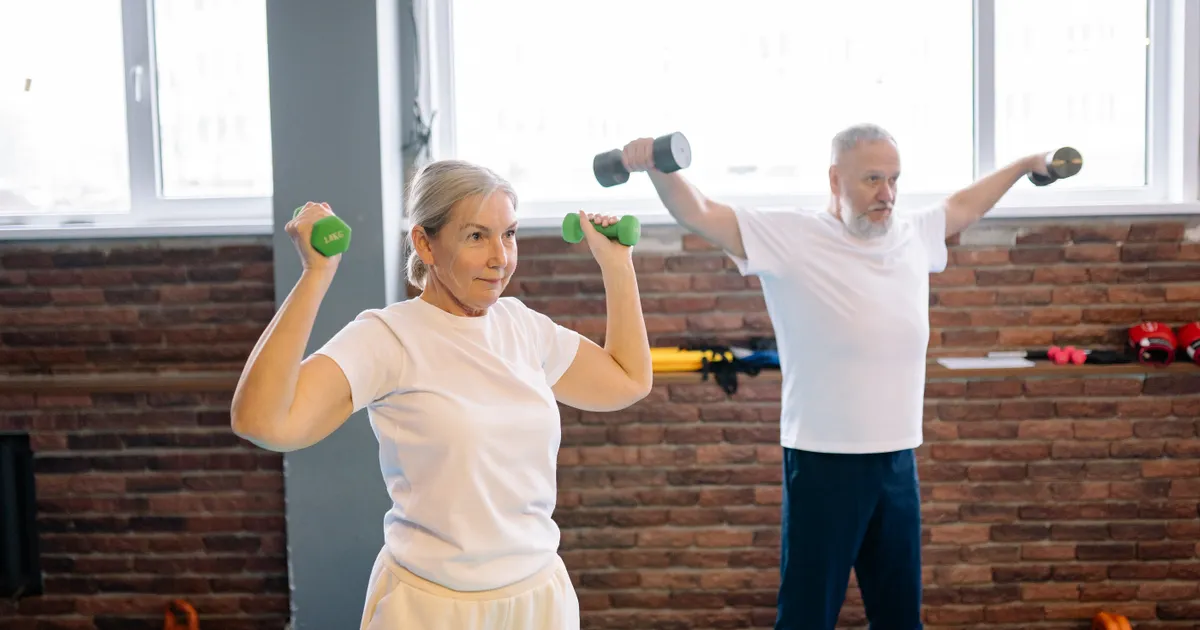
Strength Training in Your 40s and 50s: What Actually Changes
 By Paul Butler · Online Coach & Personal Trainer
I turned 45 a while back, which mostly means my knees now have opinions. They are not always constructive and they are rarely well timed.
There is a particular tone that fitness content takes with people over forty. Either everything is collapsing and you need a supplement stack to hold it together, or it pretends nothing changes at all and hands you the same programme it gives a 22 year old.
Both are wrong, and the truth is considerably more encouraging than the first one. Some things genuinely change after forty. Fewer than you think, and mostly not the ones people worry about.
What actually changes about training after 40?
Four things: recovery takes longer, warming up stops being optional, sleep matters more and is usually worse, and old injuries need working around. What does not change is the way muscle is built. Same movements, same progression, same consistency, spaced a little more carefully.
The underlying problem is not your metabolism, which gets blamed for everything and is largely innocent. It is muscle.
Harvard Health puts the figure at roughly 3 to 5% of muscle mass lost per decade after the age of 30, and higher for people who are sedentary. That is quiet, cumulative, and almost invisible year to year, which is exactly why it catches people out. Nobody notices losing a small percentage. Everybody notices when the shopping suddenly needs two trips.
And here is the bit that matters: much of that loss is not ageing. It is disuse. The body is efficient and it does not maintain tissue it is never asked to use. So a good chunk of what gets filed under "getting older" is actually "stopped doing anything demanding around 2011".
Which is genuinely good news, because disuse is fixable and ageing is not.
Changes and non-changes, side by side

| What genuinely changes | What does not change |
|---|---|
| Recovery takes longer. Three hard sessions with rest between beat five rushed ones. | How muscle is built: lift something challenging, regularly, and make it gradually harder. |
| Warming up stops being optional. Five to ten minutes, every session. | Protein still does the same job, and you still need enough of it. |
| Sleep matters more, and is usually worse. It blunts recovery and raises hunger. | Progressive overload still works. A little more weight or one more rep. |
| Old injuries need variations that do not hurt, rather than stopping. | You can still get considerably stronger. People build muscle into their seventies. |
If anything the case for training gets stronger with age, not weaker. At 25 it is about how you look. At 50 it is about carrying your own shopping, getting off the floor unaided, and not breaking a hip at 80. That is a considerably better reason, and it is the reason I would put on the poster.
And if you are new to lifting or coming back after years away, you are in one of the groups that responds best of all, which I covered in how to lose weight and build muscle at the same time.
Working around what your body has to say
Most people over forty have something: a dodgy shoulder, a knee that grumbles, a back that remembers a house move. The mistake is treating that as a reason to stop rather than a reason to choose differently. There is almost always a version of a movement that works.
"As someone living with M.E., I was nervous about finding a PT who got it. He adapts every workout to my current abilities and never makes me feel guilty on days when I can't manage much."
That is the whole approach in one review. Adapt the session to the body in front of you, and stop treating a bad day as evidence of anything.
Perimenopause, honestly and briefly
Worth addressing directly, because it is the question I get most from women in this age bracket and the available content is mostly either clinical or frightening.
The changes around perimenopause and menopause are real. Falling oestrogen affects muscle, bone and how you recover, and plenty of women find that what worked at 35 does not work the same at 48. That is not you failing and it is not in your head.
What I will say confidently as a coach: resistance training is one of the most useful things you can do through it, for muscle, for bone density and for how you feel. It is the intervention with the best case behind it and it is not on prescription.
What I will not do is pretend to be a menopause specialist, because I am not one. If symptoms are affecting your sleep, mood or daily life, that is a GP conversation and there are treatments genuinely worth discussing. Get that sorted alongside the training rather than instead of it, and be wary of anyone selling you a supplement for it.
And the men's version of the same trap: "low energy in your forties" is a large market dominated by people selling testosterone boosters. If your energy has genuinely fallen off a cliff, that is a blood test at your GP, not a purchase. Nine times out of ten the answer turns out to be sleep, alcohol, or the fact that nothing has been asked of your body in a decade.
What I would actually have you do
Nothing clever. It rarely is.
Two or three sessions a week, full body, built round a push, a pull, a squat and a hinge. Leave a day between them. Warm up properly. Add a little weight or a rep when it starts feeling manageable, which is the entire mechanism. Get protein into most meals. Walk on the other days.
That is the programme. It looks unimpressive written down and it is the thing that works, which is roughly the argument I made in not chasing unrecognisable.
If time is the barrier rather than knowledge, start smaller than you think you should. Ten minutes done regularly beats an hour you keep postponing, and the smallest possible version of your workout has the sessions written out. Sleep is the other lever, and it is the subject of the 8-hour sleep rule.
One honest caveat before you start. If you have a heart condition, unmanaged blood pressure, a joint problem you have never had looked at, or you have genuinely not moved in years, have the GP conversation first. It costs you one appointment and it is the difference between training for decades and stopping in week three.
Frequently asked questions
Is it too late to start lifting at 50?
No, and it is closer to the opposite. People build strength and muscle well into their seventies, and starting from a lower base means the early progress is faster and more noticeable. The main adjustment is recovery time between sessions rather than the training itself.
How many times a week should I train in my 40s?
Two or three full-body sessions with a rest day between them suits most people, and beats five rushed ones. Recovery is the limiting factor at this age, not effort, so the extra sessions usually cost more than they add.
Should I lift heavy or stick to light weights?
Challenging weight for moderate repetitions, with good technique, is what tells your body to keep the muscle. Very light weights for endless repetitions do little for strength. Heavy does not mean maximal: it means the last couple of repetitions should be genuinely hard.
Does exercise help with perimenopause symptoms?
Resistance training has a good case behind it for muscle, bone and general wellbeing during this period, and it is worth doing regardless. It is not a treatment for symptoms, and if symptoms are affecting your life, your GP has options that a training plan does not.
Why am I so much more tired than I used to be?
Usually sleep, alcohol, stress and years of being under-challenged physically, in roughly that order. Occasionally it is something medical like thyroid function or low iron, which is why persistent unexplained fatigue is a blood test rather than a supplement purchase.
My knees hurt when I squat. Should I stop?
Stop that variation, not squatting. Box squats, a shallower range, or leg press often feel fine when a deep barbell squat does not. Pain that persists, swells or comes from a specific incident needs looking at properly rather than working around.
That puts you in the group that responds fastest, which is a genuinely nice place to start from. DM me STARTING on Instagram @paulbutler.coach and I'll send you The Starting Point: five days of the fundamentals, then a four week plan built round your week and whatever your joints have to say about it. No cost, no catch.
Rather just talk it through? Book a free 15-minute call.
Or begin right now at paulbutlercoach.co.uk, and read The Smallest Possible Version of Your Workout if time is the problem.
More honest guides on fat loss, nutrition and training
This article is general information, not medical advice. If you have a heart condition, joint problems, are on regular medication, or have not exercised in a long time, speak to your GP before starting. If you are experiencing perimenopause or menopause symptoms that are affecting your life, that is a GP conversation and there are treatments worth discussing. Harvard Health Publishing on age-related muscle loss is linked in the text. Images sourced from Pexels (free to use): Yan Krukov, Kampus Production.
